How to Serve Divorce Papers in California
If you file for divorce, the law requires you to serve your spouse divorce papers. Serving divorce papers is the process where you, the petitioner, deliver filed documents to the respondent to make sure that they are officially notified of the divorce proceedings. Before divorce papers are served in California, the petitioner’s filed paperwork must be in line with the state laws and court requirements.
A legal divorce notice must be given to the respondent through service of process to make sure that the respondent is adequately informed of the case and can then respond to it. Different service methods, including personal service, substituted service, mail service and service by publication, can be used to serve the divorce papers.
On-Call Legal Process Servers have been trusted leaders for over 16 years in the legal process, serving across California. Our team has efficient expertise in making sure that divorce papers are served appropriately and documented in full compliance with court requirements. Contact us today for a free consultation and let our experienced process servers handle the complexities of serving divorce papers.
We’ve put together a comprehensive guide that covers what you need to know about serving divorce papers in California. You’ll learn the required documents for serving divorce papers, who can serve divorce papers, the costs involved and what to do if the respondent is difficult to find.
What is Divorce Paper Service in California?
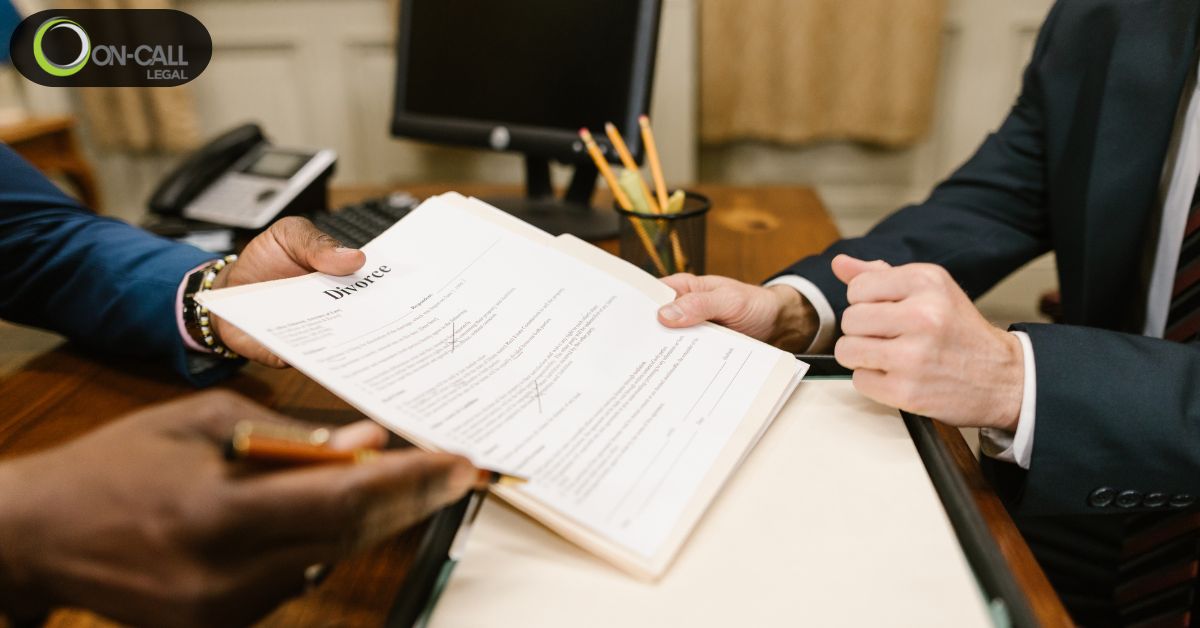
Divorce paper service in California is a legal process involving the petitioner notifying the spouse that divorce proceedings have been initiated against them. This process, called service of process, is fully required by law to provide proper notice and allow the responding spouse full access to participate in the case.
The service of process must adhere to the legal procedures that have been stated in California process server laws to make sure that the recipient receives the critical documents in a legally recognized manner.
Why Serving Divorce Papers is Necessary
Serving divorce papers protects the right of the respondent to participate in the proceedings and relieves the petitioner of delays or disputes that are deemed unnecessary. Properly served divorce papers ensure that:
The respondent knows about the legal proceedings, which prevents future arguments on being unaware of the case.
The respondent has full access and a 30-day opportunity to file a response (Form FL-120). During the timeframe, they can decide to either agree, contest, or negotiate terms regarding child custody, property division, or spousal support.
The court gains complete jurisdiction over the case. Divorce in California cannot legally move forward unless the court has proof that the respondent was served.
There’s guaranteed protection against fraudulent claims. Serving divorce documents correctly creates a documented record that prevents the respondent from later claiming they were unaware of the divorce.
The petitioner avoids case dismissal or delays due to non-alignment with California’s process server laws. If not, the case may be dismissed, or additional requirements and steps will be demanded to rectify the issue.
The court can proceed with a default judgment in favor of the petitioner in cases where the respondent chooses not to respond.
Beyond aligning with the California process server laws, California laws also require that the process server delivers the documents personally to the respondent or a qualified recipient (must be up to 18). A proof of service form (FL-115), which will be discussed in detail later, must also be provided confirming that the papers were served correctly.
Required Divorce Documents for Proper Service of Process
Some specified legal divorce documents must be delivered to the respondent to serve divorce papers appropriately in California. These important documents include:
Summons (Form FL-110)
Summons (Form FL-110) is a document that officially states that the respondent has been notified of the divorce case filed against them. It provides them with laid down instructions on how they must respond and a legal warning of a 30-day timeline response.
Petition for Dissolution of Marriage (Form FL-100)
Petition for dissolution of marriage (Form FL-100) is the legal document that requests the dissolution of marriage in a formal process and specifies the petitioner’s request concerning property declaration, child custody, and any other legal grounds for divorce. Once the form is completed and served, the respondent can agree, negotiate, or contest the terms through their formal response.
Proof of Service of Summons (Form FL-115)
Proof of service of summons (Form FL-115) symbolizes the court’s confirmation that the respondent was properly served. The individual who served the divorce papers must fully complete and sign the form.
Response Form (Form FL-120)
A response form (Form FL-120) is an optional document where the respondent is allowed to file their official response to the divorce petition, The form is also where they can either agree with the petitioner’s terms or contest issues related to child custody, spousal support or asset division.
Additional Local Court Forms for Divorce Petition
Some countries demand additional local court forms depending on the specifics of the divorce case, such as child custody, financial disclosures, or support agreements. Since local requirements vary for different countries, it is compulsory that all petitioners check with the court where the divorce was filed to see that all necessary documents are included in the service packet.
Notice of Acknowledgment and Receipt (Form FL-117)
Notice of acknowledgment and receipt (Form FL-117) is used only in cases where the petitioner serves the respondent by certified mail. The form is used when the respondent voluntarily agrees to accept service by both signing and returning the acknowledgment.
Who Can Serve Divorce Papers in California?
In California, divorce papers are mandated to be served by third parties that meet all legal requirements to see to it that the process is valid and can be adequately enforced by the court without restrictions. The person serving the documents must be at least 18 years old and must not, in any way, be the petitioner.
A professional process server has proven to be one of the most reliable options. Process servers have been trained to serve complaint legal documents, locate individuals that are termed difficult to find, and see to it that the proof of service of summons is filled appropriately and filed with the court.
A friend or family member can personally serve the papers, but only if the person is at least 18 years old and is not directly or indirectly involved in the case.
The sheriff’s department of the respondent’s country is another option, mainly if the respondent is very difficult to locate. The workload of the county sheriff could result in slower service times even though they are legally authorized to serve papers.
Meanwhile, a registered process server can also serve as an alternative method for those who would prefer to hire a professional firm. These individuals are licensed in California and stick to strict legal procedures that comply with state laws. The registered process server option is an especially appropriate one when serving papers to a respondent who is at work, a gated community or any location where access is restricted.
How to Serve Divorce Papers in California Without Issues
To serve divorce papers in California without any form of complication, the petitioner must stick to the correct legal process, choose the appropriate service method, and make sure that all divorce paperwork is documented and filed with the court. Here’s a full breakdown of the serving process:
1. Prepare the Divorce Papers
Before serving divorce papers, they must have been obtained, completed, and filed with the court. The necessary forms, including the Summons (FL-110), which we’ve discussed earlier, are found with the county court, the California courts website or through a family law attorney. Once completed, the petitioner must file these documents with the court clerk and pay the necessary filing fee.
2. Choose the Method of Service
California law provides different options for serving papers depending on whether the respondent is easily reachable or not. The most common methods include personal service, substitute service, service by mail, and service by publication.
Personal service is the most preferred and straightforward method. The server must physically hand the divorce papers to the respondent, confirm their identity, and ensure the documents are delivered directly. Substituted service, which includes electronic service, is used when the respondent is unavailable or avoiding service. The papers can be left with a responsible adult at the respondent’s home or workplace. Moreover, the server must mail a copy of the documents to the same address.
Moreover, service by mail is a good option only if the respondent willingly and voluntarily agrees to accept service by mailing. They will have to sign and return a notice of acknowledgment and receipt (Form FL-117), which is then filed with the court. Service by publication is often the last resort and is mostly used in cases where the respondent’s location is difficult to find. However, before the publication is done, prior approval from the court is required to publish a notice in a local newspaper for a specific period.
3. Hire the Best California Divorce Process Server
Hiring a professional process server helps to make sure that divorce papers are legally and efficiently served. Process servers are trained to locate difficult-to-find respondents and legally serve documents. Working with a reliable divorce process server helps validate the service and prevent unnecessary legal setbacks.
4. Complete the Proof of Service form
The proof of service is a document the court requires to confirm whether the respondent was legally served. The process server must have signed and completed the document before it is filed with the court. In some cases, the process server will have to swear the document under oath to make it formal. In other words, the sworn document is called an affidavit of process service.
Different proof of service forms are used depending on the method:
- Proof of personal service (FL-115) confirms in-person service.
- Proof of service by mail applies mainly when the spouse signs an acknowledgment form voluntarily.
- Proof of service by publication is required when the court approves public notice in a newspaper.
Delays or even case dismissal may occur when the proof of service form is not filed correctly or in due time. Moreover, if the court does not receive valid proof that the respondent was served, the petitioner must repeat the process and refile additional documents.
What Happens if You Can’t Serve Someone’s Divorce Papers?

If you are not able to serve divorce papers, the case cannot proceed until the court is satisfied that reasonable efforts have been made to notify the respondent. This is very similar to what happens if you can’t serve someone with court papers. Failing to serve the divorce paper will automatically lead to delays because you may have to restart the service process or request alternative service methods.
Attempt Multiple Service Methods
Should there be a case where the respondent is avoiding service, the court system expects you to make multiple attempts using different methods. You can decide to use personal service, substituted service, or service by mail if the respondent agrees to sign a return receipt.
Hire a Professional Divorce Process Server
Hiring a professional divorce process server will help locate respondents who are difficult to find and serve them efficiently. They use advanced tracking techniques to make sure that the documents reach your spouse in a legally recognized manner.
Professional process servers also understand legal service procedures and can help you complete your service in full compliance with California law. This way, you can avoid any form of delay or error that could affect your case. Schedule a call now to get a free consultation from On-Call Legal Process Servers.
Use a Private Investigator
For spouses actively evading service, a private investigator may be necessary to track them down using public records, social media, or, worst cases, surveillance techniques. Suppose the respondent cannot be found after reasonable efforts. In that case, the petitioner can request a court order for alternative service, including service by email, courthouse posting or social media.
Consult a Family Law Attorney
If it gets to the point where legal complexities arise, consult a family law attorney to make sure that the service complies with court rules and that the divorce process moves forward. A Family law attorney can advise on alternative service methods if the respondent is actively avoiding service. However, keep in mind that the respondent is subjected to penalty for avoiding the service of process.
What to Do If You Can’t Locate Your Spouse to Serve Divorce Papers
If you cannot locate your spouse’s home to serve divorce papers, you must follow some other steps to find them before you request court approval for alternative service. Courts generally require that all reasonable attempts must been made in finding someone to serve them court papers before permission is granted for methods like service by publication or posting. The steps to how to find your spouse to serve them divorce papers include:
Check Their Last Known Address
Begin by checking their last known address. Visit their most recent residence, workplace or any locations they could have frequently visited to ascertain if there’s a possibility that they are still reachable.
Contact Friends and Family
Next, contact members of their family, friends or even coworkers who will be able to provide information on where they might be. In most cases, people close to the respondent know precisely where they have moved and the best way to communicate with them.
Search Public Records
Thoroughly review their public records, such as DMV records and voter registration, to track down any recent change in residence or relocation cases. Using social media and online searches is important and helpful. Assess their recent activities on social platforms like Facebook, LinkedIn, or Instagram to see if there could be location clues in check-ins, tagged locations, or employment updates.
Request Service by Publication
As discussed earlier, requesting service by publication is another option if your spouse’s whereabouts can still not be found after thorough efforts. Based on the request, the court can approve a legal notice to be published in a newspaper when all other methods have failed. For more insights, check out how to find someone to serve divorce papers.
How Much Does It Cost to Serve Divorce Papers in California?
The cost of serving divorce papers in California ranges from $50 to $100. However, costs may also be higher depending on the service method, the case complexity, and the number of attempts required. Ultimately, process server fees in California vary depending on whether you’re using the sheriff’s department or hiring a private investigator.
Using the sheriff’s department for service costs between $40 and $50, although qualified individuals are offered fee waivers in some countries. On grounds where service by publication is required, newspaper fees range from $100 to $500. The cost can be higher depending on the location and publication and is only approved by the court when the respondent cannot be found after due diligence.
The cost of hiring a private investigator is over $300 to $1,000+ and highly depends on the case complexity and the time spent locating the individual. Additional charges apply for rush service, multiple attempts, or serving at different locations.
How Much Time Do You Have to Serve Divorce Papers in California?
As the petitioner, you are meant to serve divorce papers to the respondent within a period of 16 days. The serving must be done before the proposed court date for the court hearing if you filed a request an order together with your petition. If service is not completed within the stated timeframe, the case will automatically be delayed or dismissed.
Additionally, if you aren’t able to serve the respondent within 16 days before the court hearing, an extension request must be filed with the court. When you do so, the court may grant you an additional timeframe if you can show that you made thorough efforts to locate and serve the respondent.
How long it takes to serve someone also depends on the circumstances surrounding the service method and the accessibility of the respondent. Once the divorce papers have been served, your respondent has a 30-day interval to file a response to the divorce petition. If they fail to respond within this given timeframe, default judgment will be put in action.
Need a Divorce Process Server in California?
Properly serving divorce papers guarantees you a moving case without unnecessary delays. To serve papers properly in California, you want to choose the appropriate service method, complete the proof of service, and adhere to all court deadlines to prevent delays and protect your legal rights. Meanwhile, failing to follow California’s rules on process service can automatically cause dismissal or legal disputes. That’s why working closely with a process server who clearly understands your jurisdictional requirements and makes sure of compliance with your state laws is important.
At On-Call Legal Process Servers are experts when it comes to offering professional and reliable process-serving solutions across California. Our experienced team makes sure that divorce papers are delivered legally and efficiently. Contact us today for a free consultation, and let’s handle all the complexities associated with process serving.


On-demand legal services with arranging services from eFiling to organizing and preparing your subpoena for records and/or personal appearance and much more.