
Proof of Service by Mail
Proof of service is a crucial legal document that confirms the delivery of court documents, such as motions, pleadings, affidavits, or notifications, to the appropriate parties. It ensures proper notification and proves that the service occurred, as improper service can lead to suspension, dismissal, or invalidation of the legal process. When legal papers are served via mail, proof of service by mail is necessary to confirm that the documents were properly sent and received by the intended recipients.
Documenting mail delivery verification is crucial in situations such as serving out-of-state parties or difficult-to-reach individuals, as personal delivery is often unnecessary or not feasible. Understanding all of the requirements for service of process can be challenging, so legal professionals frequently use process servers to manage these tasks accurately.
If you’re facing a legal situation requiring service of process, don’t hesitate to reach out to On-Call Legal Process Servers. Let our team of experts help make the delivery process smooth and worry-free so you can focus on what matters most—your case. Contact us for a free consultation today!
This post will discuss proof of service by mail by explaining what it is and outlining when it’s needed, how to complete and file it, common legal issues, and how to prove service. Additionally, it will cover how to establish service, what to do if the recipient doesn’t receive the mail, and how to handle insufficient proof.
What Is Proof of Service by Mail?
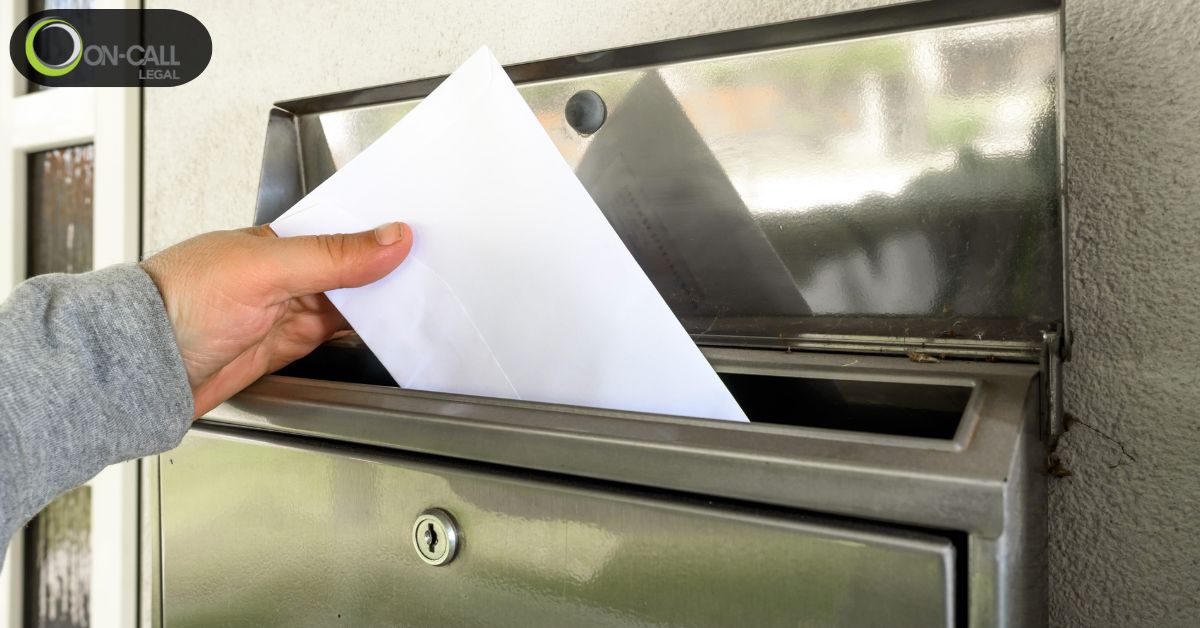
Proof of Service by Mail is a legal document that verifies the successful delivery of legal papers to the appropriate parties via mail, and makes sure due process is followed. This proof is essential because it acts as legal evidence that the recipient was properly notified about the legal proceedings.
Unlike personal service (where documents are physically handed to a person) or electronic service (where documents are delivered digitally), service by mail relies on the postal system. After the documents are sent, the person who mails them completes the proof of service form detailing when and to whom the legal papers were mailed. This form is then filed with the court, providing a record that the service was properly carried out. Without proof of service, the court may dismiss the case, suspend proceedings, or invalidate actions taken.
Certain legal conditions must be fulfilled for the proof to be considered legitimate. The documents must be mailed to the right address within the court-specified timeframes, and the individual mailing them cannot be personally involved in the case. Failure to complete these conditions might lead to issues, delays, or even case dismissal.
This is where process servers come in. They are experts who have been trained to manage the intricacies of serving court papers, guaranteeing that everything is completed accurately and following the law. By employing a process server, you can prevent errors and ensure your evidence of service is submitted on time and complies with the law.
Who Can Serve Papers by Mail?
When serving legal papers via mail, the person handling the mailing must comply with specific legal criteria. Typically, the parties involved in the lawsuit cannot serve original papers themselves. Rather, the person who can serve court papers is a qualified third party, such as a process server, who is at least 18 years old and not directly involved in the legal process.
Although it might be tempting to serve papers personally to save time, you should refrain from doing so because there could be conflicts of interest. Serving documents personally might invalidate the process since it allows disagreements over whether service was done correctly.
It is advisable to hire a process server to be certain that all legal criteria are satisfied and to prevent any legal pitfalls that might cause your case to be delayed or become more complicated. Since they know the specifics of service laws, you can be sure that the documents are accurately served, properly recorded, and filed on time.
When Is Proof of Service by Mail Used?
Proof of service by mail is used in legal proceedings where papers were served via mail, particularly when personal delivery of documents was not feasible or necessary. This document confirms that essential court papers, such as summons, complaints, motions, and legal notices, have been sent to the appropriate parties via mail. For instance, if a party involved in a lawsuit is located out of state or in a remote area, service by mail can provide an efficient and effective way to notify them, after which it’s necessary to obtain a proof of service by mail.
Additionally, service by mail can be an appropriate option when personal service might lead to uncomfortable interactions or when all parties agree that mailing the documents suffices as a formality. However, this approach necessitates close attention to regulatory criteria and deadlines to ensure that the proof of service obtained is valid and compliant with legal standards.
How to Serve Someone by Mail and How to File a Proof of Service by Mail?

Serving someone by mail is a common method used when personal service is not practical, such as when the recipient lives out of state, and obtaining and filing a proof of service by mail is necessary as it lets the court know that the legal papers were sent to all the right people. Below, we’ve provided a step-by-step process of how to serve papers via mail and how to file a proof of service by mail.
Prepare the Documents
Ensuring all legal paperwork is ready and complete before sending anything is crucial. Depending on your particular situation, this paperwork may include several key documents, such as summons, complaints or notices. Additionally, any other court-related filings, such as petitions or motions, must also be prepared. Before proceeding to the next stage, it is essential that these documents are accurate and organized.
Address the Documents
The next step is to address the envelope after your documents are prepared correctly. Inaccurate data can result in interruptions in service or delays. Be sure to put the recipient’s full legal name and use the full and accurate address. Double-check this to ensure accuracy. Also, include your return address in the top left corner so that the documents can be returned to you if undeliverable. This step ensures that your legal papers reach the intended recipient and can be tracked down if needed.
Choose the Mailing Method
The method you choose to mail the documents is important for ensuring that the court accepts the service. There are several mailing options to consider:
- Certified Mail: This is the most secure option, as it provides both a mailing receipt and a return receipt (the green card) that verifies delivery.
- First-Class Mail: This is a more economical option but doesn’t offer tracking or proof of delivery, which may not be sufficient in some legal cases.
- Priority Mail: This method is faster and includes tracking, but it’s more expensive than First-Class. It’s useful for when timely delivery is necessary.
Mail the Documents
Once the shipping method has been chosen and the envelope has been correctly addressed, it should be taken to the post office or put in a mailbox. Save the receipt; it can be used as evidence of mailing, especially if you’re using certified or priority mail.
Complete the Proof of Service by Mail Form
After mailing the documents, a Proof of Service by Mail form must be completed. This form is critical, confirming that the documents were sent. The form typically requires:
- The name and address listed of the person being served for accurate identification.
- A detailed description of the documents sent (e.g., summons, complaint, notice).
- The mailing date and method used (e.g., Certified Mail, First-Class).
- Your signature, which affirms that all the information provided in the legal papers is truthful and accurate.
Please double-check all information before submitting it, as any errors like unsigned proof can cause the Proof of Service to be rejected by the court.
File the Proof of Service by Mail with the Court

After completing the form, it must be filed with the court to confirm that service was performed. To file the proof of service correctly, follow the court’s procedures closely. This typically involves submitting the form either in person at the court clerk’s office, by postal service, or through an electronic filing system if your jurisdiction allows it. Make sure that you keep a copy of the filed document for your records.
Common mistakes to avoid when filing the proof of service include:
- Missing signatures: Make sure that the legal papers are signed by the server or the person responsible for mailing the documents.
- Incorrect dates: Verify that all dates on the form accurately reflect when the service was performed and when the form is being submitted.
- Filing late or missing the deadline: Be aware of any deadlines for filing the proof of service to avoid delays in your case.
- Incomplete or incorrect details on the form: Double-check that all required information, such as names, addresses, and case numbers, is complete and accurate.
These mistakes can delay your case or possibly require restarting the service process. The legal process can be maintained by precisely and immediately filing the Proof of Service, which guarantees that the court will acknowledge your efforts to notify the other parties.
By carefully following each stage, you can guarantee compliance with legal standards and prevent unnecessary challenges in your case. The legal process can proceed without problems if the Proof of Service by mail is correctly filed and shows the court that all parties have been notified.
Legal Issues with Proof of Service by Mail
If proof of service by mail is not handled properly, it can lead to significant legal issues. For instance, if the proof of service is incomplete or incorrectly filled out, it may not satisfy the court’s requirements, potentially jeopardizing your case.
Another common error is not retaining a copy of the original proof of service form. If the court finds invalid proof of service in California, it can cause challenges or rejections due to incorrect procedures or missing or insufficient form information. Legal proceedings may be delayed because the opposite party does not recognize it as legitimate notice.
To prevent these problems, confirm mail receipt and use certified mail with a return receipt (green card). If the proof of service is insufficient, legal options include trying a different approved method, seeking substitute service, or exploring other court-approved options if the receiver is difficult to contact.
How to Prove Service by Mail?
Maintaining your legal process’s integrity requires you to prove postal service. One of the simplest and most effective ways to do this is by obtaining a mailing receipt. Services like USPS Certified Mail provide a receipt for the documents that are sent, and more importantly, the recipient signs a return receipt, sometimes known as a “green card,” upon arrival. This return receipt provides conclusive proof that the legal papers were sent and received.
Other tracking alternatives, such as USPS tracking or comparable services, might be helpful in addition to certified mail. These methods provide you with an extra degree of verification by confirming when the legal papers were transmitted and when they arrived.
What Happens if the Recipient Doesn’t Receive the Mail?
Legal actions can get delayed if the receiver refuses to accept the mail or says they never got the documents served. Until proof is presented, the court cannot consider the service complete, which might put your case on hold. In such cases, the sender might have to try again by personal service or using a different mailing method. If delivery is not confirmed, you may have to start the process from scratch, which can take time and may cause problems for your legal case.
To prevent delays, it’s important to maintain all documentation and other papers and use reliable postal service, such as certified mail. Documentation of mailing and delivery can help settle disputes about delivery quickly and ensure your case moves forward.
What Do I Do if I Can’t Get Proof of Service?

If proof of service is not obtained, you should act quickly to prevent delays in your legal process. Here’s what you can do:
First, contact the person handling document service or the process server to inquire about the specifics related to their attempts at serving the documents. If service was attempted but failed, the process server should have recorded their actions. This information can help you assess what went wrong and whether a different strategy is required to obtain proof of service.
If traditional methods of service, such as mail or personal delivery, are not successful, consider using alternative service methods. Courts often allow alternative methods, such as service by publication in a local newspaper or substitute service, where papers are left with an accountable party at the recipient’s residence or place of business. These alternatives can sometimes facilitate obtaining the necessary proof of service.
The process server may submit an affidavit of attempted service in certain circumstances after several attempts have been made to serve the documents. This affidavit, which you can submit to the court as proof that you made an attempt to comply with your legal duties, details all of the attempts you made to serve the documents.
Lastly, if all else fails, you may need to request the court’s permission to serve the documents in a different manner. Courts sometimes permit alternative methods when traditional methods are ineffective. This could include serving someone via social media or email in certain situations. By exploring these options, you can work towards obtaining the proof of service needed to proceed with your legal case.
Need a Professional Process Serving Company?
If process service was conducted via mail, proof of service by mail is necessary in order to guarantee that all parties have been notified and that your case can move forward without delays. Every stage of the process, from selecting the best mailing method to maintaining correct records, calls for close attention to detail in order to prevent expensive errors. If you don’t have enough evidence, your case may be dismissed or experience additional challenges.
Collaborating with an experienced process serving business is frequently ideal to guarantee adherence to legal criteria. Professional process servers are adept at handling the nuances of serving documents via mail and other official channels. They may assist in making sure that your documents are served in a timely, accurate, and court-mandated manner, and that you get the necessary proof of service.
If you’re unsure about the process or need assistance, don’t hesitate to seek legal advice from On-Call Legal Process Servers. Contact us today for a free consultation to get started!


On-demand legal services with arranging services from eFiling to organizing and preparing your subpoena for records and/or personal appearance and much more.